

Ai Powered Digital Marketing Course in Telugu: Explore AI-Driven Audience Research
Introduction
Audience research is the foundation of effective digital marketing. Before a brand creates ads, blog posts, emails, landing pages, or social content, it needs to understand who it is trying to reach and what those people actually care about. AI can make this process faster by helping marketers organize feedback, group customer questions, compare patterns, and explore possible audience segments.
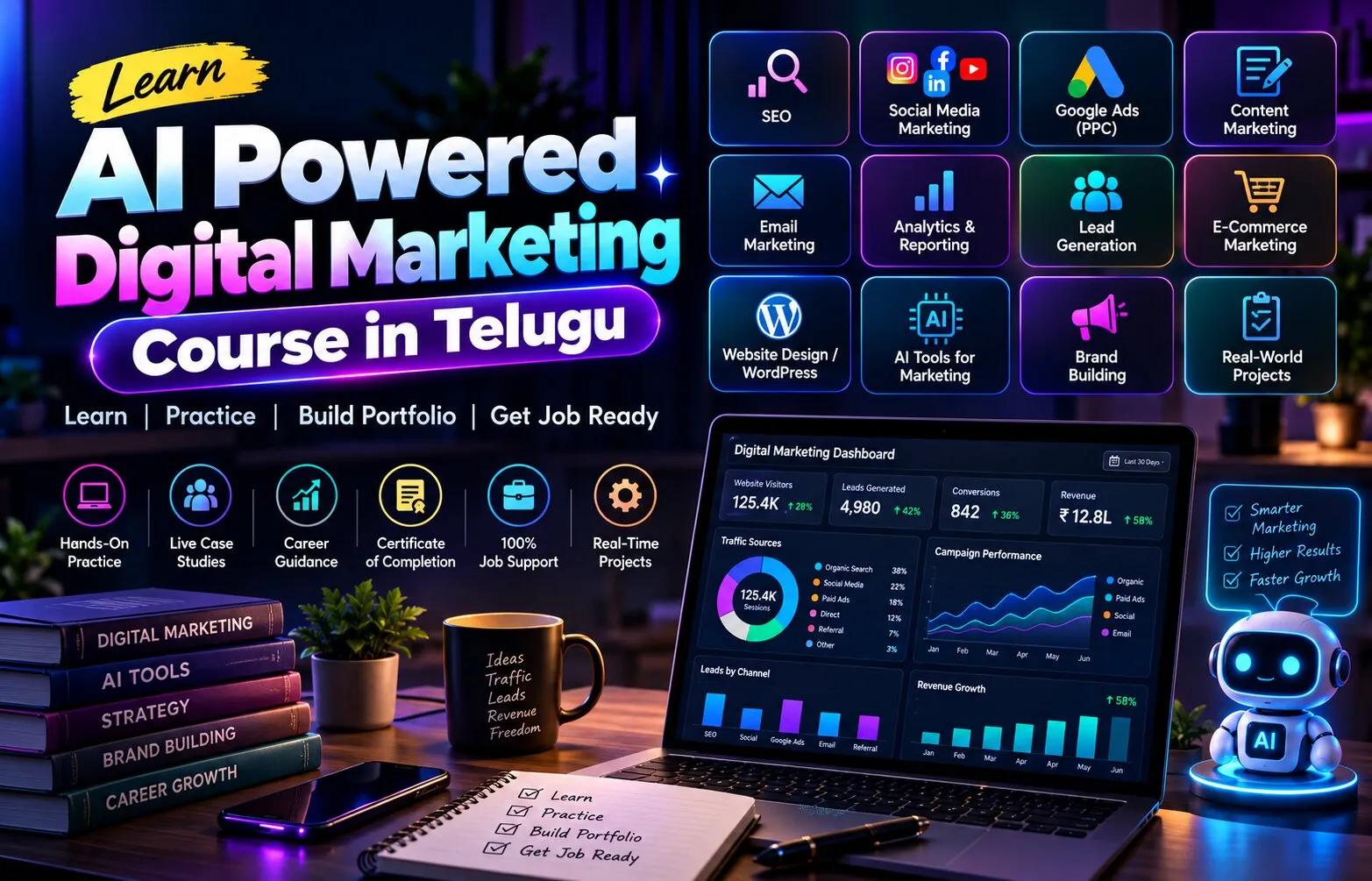
An Ai Powered Digital Marketing Course in Telugu can help learners understand how AI supports audience research without replacing real customer data. The objective is to combine AI-assisted analysis with search behavior, CRM information, surveys, comments, and campaign performance so that marketing decisions are based on evidence rather than assumptions.
Start with Real Audience Signals
Good audience research begins with information that already exists.
Useful sources include:
Website analytics
CRM records
Search queries
Customer surveys
Sales calls
Support tickets
Social media comments
Email responses
Webinar questions
Product reviews
These sources reveal how customers describe their problems in their own words.
AI can help summarize this information, but it should not invent audience behavior that the business has never observed.
Use AI to Group Customer Questions
Suppose a training company collects hundreds of questions from students.
The questions may relate to:
Fees
Course timing
Career outcomes
Prerequisites
Projects
Certification
Support
Reading every question manually can take time.
AI can help group similar questions into categories.
For example, ten differently worded questions about coding prerequisites can be placed under one theme.
The marketer should still review samples from each group to make sure the classification is accurate.
Build Useful Audience Segments
Audience segmentation divides a larger audience into smaller groups with meaningful differences.
Possible segments include:
Beginners
Working professionals
Career switchers
Existing customers
New leads
High-intent visitors
Returning website users
The purpose is not to create unnecessary complexity.
Segments should exist because they require different messages, content, or offers.
For example, a beginner may need a roadmap, while a working professional may care more about flexibility and practical application.
Use AI for Persona Drafting
A persona is a simplified profile that represents a type of customer.
AI can help organize real research into a concise persona.
For example:
Career Stage: Final-year student
Goal: Build job-ready technical skills
Main Questions: Which skill should I learn? What projects should I build? Do I need prior experience?
Preferred Content: Step-by-step guides, demos, roadmaps, and project examples
This persona should be treated as a working summary, not as a fact that describes every individual in the segment.
Analyze Search Intent
Search behavior can reveal what people want at different stages.
Compare:
“what is digital marketing”
“digital marketing tools”
“digital marketing course in Telugu”
These searches suggest different levels of awareness and intent.
AI can help classify large keyword lists by likely intent, but marketers should verify this by looking at actual search results and available search data.
Search behavior is valuable because it shows what people are actively trying to find.
Study Website Behavior
Website analytics can reveal:
Popular landing pages
Traffic sources
Device usage
Conversion pages
Exit points
Returning visitors
Content engagement
Suppose many users reach a course page from mobile devices but few complete the form.
That observation may lead to a new question:
Is the mobile form difficult to use?
AI can help summarize these patterns, but the website data remains the evidence.
Use Social Media as a Research Source
Comments, polls, direct messages, and post engagement can provide useful audience signals.
For example:
A post about interview preparation may receive more saves than a general motivational post.
A poll may show that learners are more confused about projects than theory.
Repeated questions in comments can reveal content gaps.
AI can help categorize these interactions and identify repeated themes.
The team should still read representative comments directly because tone and context matter.
Analyze CRM Data Carefully
CRM data may include:
Lead source
Course interest
Location
Stage
Qualification
Campaign
Outcome
A marketer can use this information to ask:
Which source produces the highest-quality leads?
Which audience segment converts more often?
Which course attracts more working professionals?
Which campaigns generate repeat enquiries?
AI can help summarize structured results, but calculations and business definitions should be verified.
Avoid Stereotypes
Audience research can become weak when assumptions replace evidence.
Avoid statements such as:
“All freshers prefer low-cost options.”
“All working professionals want weekend classes.”
“All people from one city behave the same way.”
These statements may be inaccurate.
Research should distinguish between:
Observed behavior.
Possible hypothesis.
Confirmed pattern.
The difference matters when marketing decisions are made.
Turn Research into Campaign Decisions
Audience research should change how marketing is executed.
It may influence:
Content topics
Ad messages
Email sequences
Landing-page sections
Webinar themes
Social media formats
Calls to action
For example, if customer questions repeatedly focus on project experience, the campaign may need more project demonstrations instead of more generic promotional content.
Practical Audience Research Exercise
Choose a fictional online course.
Collect sample information from:
Twenty customer questions
Ten search queries
Ten social comments
Basic CRM fields
Use AI to group the information into themes.
Then create:
Three audience segments
One short persona for each
Five content ideas
Three ad-message angles
Two follow-up questions for further research
Finally, mark which conclusions are supported by evidence and which are still hypotheses.
This step prevents AI-generated assumptions from becoming campaign facts.
Frequently Asked Questions
Can AI identify a target audience automatically?
AI can help organize data and suggest patterns, but marketers should validate audience decisions using real customer and behavioral information.
What are the best sources for audience research?
CRM data, analytics, surveys, interviews, search queries, social interactions, support questions, and sales feedback are all useful.
Are personas always accurate?
No. Personas are simplified summaries and should be updated when new evidence appears.
Why is audience research important before content creation?
It helps marketers create messages that address real questions instead of assumed needs.
Conclusion
An Ai Powered Digital Marketing Course in Telugu can help learners understand audience research as the starting point for stronger marketing.
AI can organize feedback, group customer questions, summarize patterns, and support persona creation. Real behavior, search data, CRM outcomes, and direct customer interactions should still guide the final decisions.
The best marketers use AI to process information faster without allowing it to invent audience truth. When research is connected to content, ads, landing pages, email, and campaign planning, marketing becomes more relevant, measurable, and useful to the people it is meant to reach.