

Introduction
Bank Accounting is an important part of SAP Finance because nearly every business depends on banks for payments, collections, transfers, fees, interest, and reconciliation. A company may record vendor payments, customer receipts, salary transfers, bank charges, and other movements every day. If these transactions are not recorded and reconciled correctly, cash balances and financial reports can become unreliable.
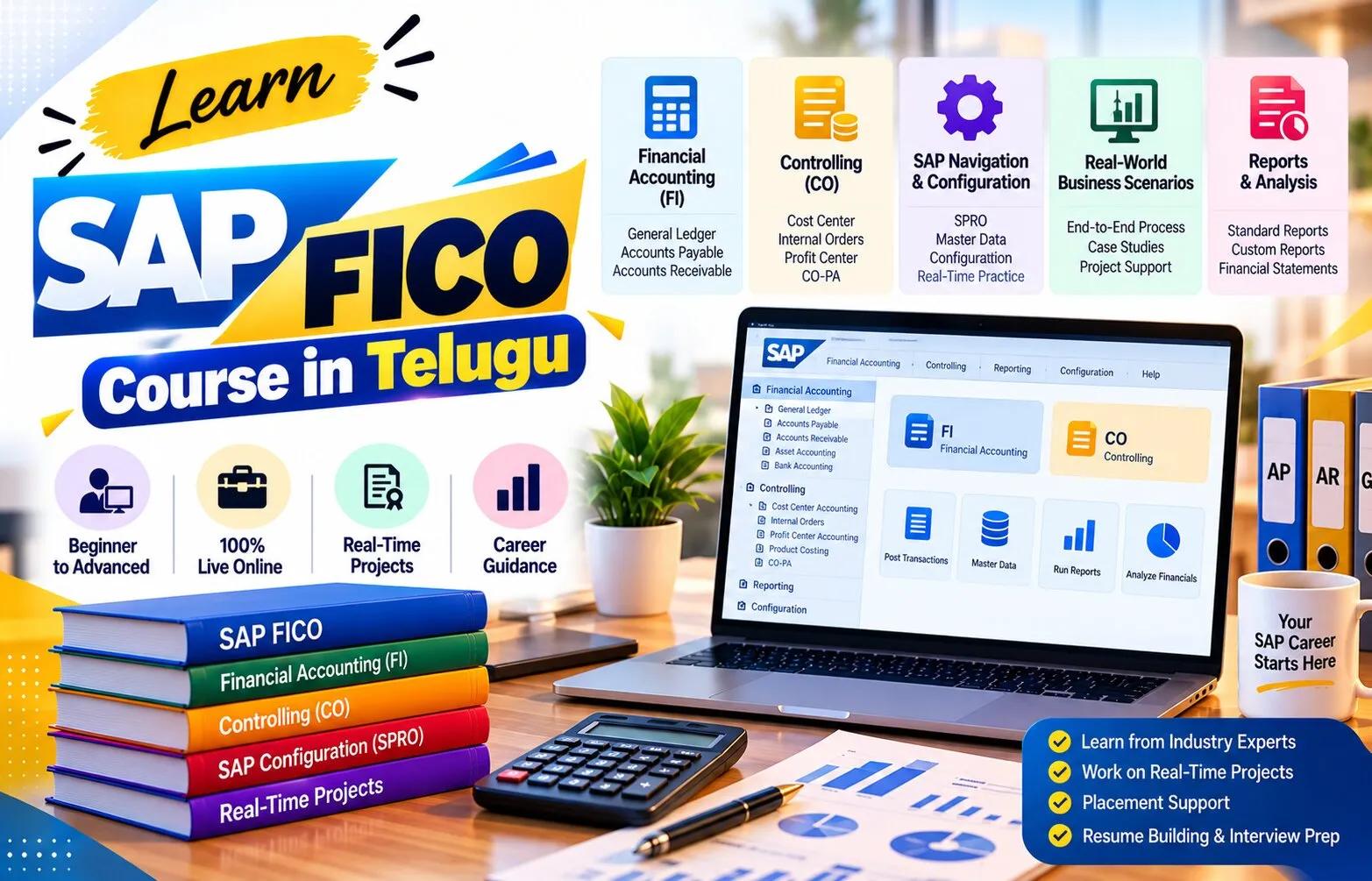
A SAP FICO Course in Telugu can help learners understand how bank-related transactions flow through SAP, how clearing accounts are used, and why reconciliation is necessary. The objective is not just to enter bank transactions, but to understand the accounting logic behind cash movement and how SAP keeps the bank ledger aligned with actual bank statements.
What Is Bank Accounting?
Bank Accounting manages financial activities that involve company bank accounts.
Typical activities include:
Vendor payments
Customer receipts
Bank transfers
Bank charges
Interest postings
Cheque transactions
Electronic bank statements
Reconciliation
These transactions affect both bank-related General Ledger accounts and customer or vendor accounts.
Understand Bank-Related G/L Accounts
A company may use several General Ledger accounts for banking.
Examples include:
Main Bank Account.
Bank Incoming Clearing Account.
Bank Outgoing Clearing Account.
Bank Charges Account.
Interest Income Account.
Interest Expense Account.
Clearing accounts help separate the timing between an internal posting and the actual bank settlement.
For example, a vendor payment may be recorded first in an outgoing clearing account before the bank statement confirms that the amount has left the bank.
Vendor Payment Example
Suppose a company owes a vendor ₹1,00,000.
The vendor invoice is already posted.
When payment is initiated, the accounting process may involve clearing the vendor liability and moving the amount through a bank-related clearing account.
After the bank statement confirms the payment, the clearing account is matched with the actual bank movement.
This staged approach makes reconciliation easier.
Customer Receipt Example
Suppose a customer pays ₹75,000 against an outstanding invoice.
The business must identify:
Which customer paid?
Which invoice should be cleared?
What amount was received?
Did the bank deduct any charges?
After matching the payment, the customer open item can be cleared and the bank balance updated.
If the payment cannot be identified immediately, it may remain in a clearing process until the correct customer is found.
What Is Bank Reconciliation?
Bank reconciliation compares the company’s recorded bank transactions with the transactions appearing on the actual bank statement.
The purpose is to identify differences such as:
Unrecorded bank charges.
Interest credits.
Timing differences.
Missing payments.
Duplicate postings.
Unidentified deposits.
The goal is to make sure the bank balance in the accounting system reflects the real bank position.
Electronic Bank Statement
Many organizations use electronic bank statements to reduce manual entry.
A bank statement file may contain:
Transaction date.
Amount.
Reference.
Value date.
Bank transaction code.
Description.
SAP can interpret the statement according to configured posting rules.
Some transactions may be matched automatically, while others require manual review.
Why Clearing Accounts Are Useful
Clearing accounts act as temporary holding accounts.
Consider a payment instruction sent today while the bank settles it tomorrow.
If the company directly reduces the main bank account before confirmation, timing differences may be difficult to track.
A clearing account allows the process to show:
Payment initiated.
Payment pending settlement.
Payment confirmed.
This creates better control over the transaction lifecycle.
Bank Charges
Banks may deduct service fees from the account.
Suppose the bank statement shows a ₹500 charge.
The accounting entry may be:
Debit: Bank Charges Expense ₹500.
Credit: Bank Account ₹500.
If the charge is not posted, the SAP bank balance may differ from the statement.
Interest Transactions
Bank accounts may generate interest income or interest expense.
Examples include:
Savings interest.
Loan interest.
Overdraft interest.
Interest must be posted to the correct accounts so that both bank balances and Profit and Loss reporting remain accurate.
Internal Bank Transfers
A company may transfer money between two of its own bank accounts.
Example:
₹5 lakh moves from Bank A to Bank B.
The transfer should not be treated as revenue or expense.
It is a movement between asset accounts.
The accounting logic must reflect the decrease in one bank account and increase in the other.
Payment Methods
SAP finance processes can support different payment methods depending on business setup.
Examples include:
Bank transfer.
Cheque.
Electronic transfer.
Other approved payment methods.
Payment method configuration can influence which bank account is used, what information is required, and how the payment is processed.
Automatic Payment Process
Organizations may use an automated payment process for due vendor items.
A typical flow includes:
Select due invoices.
Create payment proposal.
Review exceptions.
Confirm payment run.
Generate payment output.
Post accounting entries.
The proposal stage is important because it allows finance users to review blocked invoices, missing bank data, or other issues before payment is executed.
Common Reconciliation Problems
Typical issues include:
Payment appears in bank but not SAP.
Payment appears in SAP but not bank.
Customer receipt has no reference.
Bank charge was not posted.
Duplicate payment exists.
Wrong amount was cleared.
The finance team should investigate the reason rather than forcing the accounts to match.
Practical Learning Scenario
Imagine a company with these transactions during one week:
Vendor payment: ₹80,000.
Customer receipt: ₹1,20,000.
Bank charge: ₹750.
Interest income: ₹2,000.
Internal bank transfer: ₹3,00,000.
For each transaction:
Identify the accounts affected.
Decide whether clearing is needed.
Explain how the bank statement would confirm the movement.
Then perform a simple reconciliation.
Frequently Asked Questions
What is the purpose of Bank Accounting in SAP?
It helps manage bank-related transactions, payments, receipts, clearing, and reconciliation.
Why are bank clearing accounts used?
They help track the timing between an internal accounting transaction and the actual settlement confirmed by the bank.
What is an electronic bank statement?
It is a structured bank transaction file that can be imported and processed in SAP according to configured rules.
Why is bank reconciliation important?
It helps identify missing, duplicate, unmatched, or timing-related differences between SAP records and the actual bank statement.
Conclusion
A SAP FICO Course in Telugu can help learners understand Bank Accounting as a complete process that connects payments, receipts, clearing, statements, and reconciliation.
The most important skill is understanding how money moves through the accounting system and why temporary clearing accounts are often required. Vendor payments, customer receipts, bank charges, interest, and transfers all have different accounting effects.