

ServiceNow Course in Telugu with AI: Understand Predictive Intelligence in ServiceNow
Introduction
Service management platforms collect large amounts of operational data through incidents, requests, cases, categories, assignment groups, resolution notes, and knowledge interactions. Predictive Intelligence uses machine-learning techniques to identify patterns in this historical data and support decisions such as classification, routing, similarity matching, and prioritization.
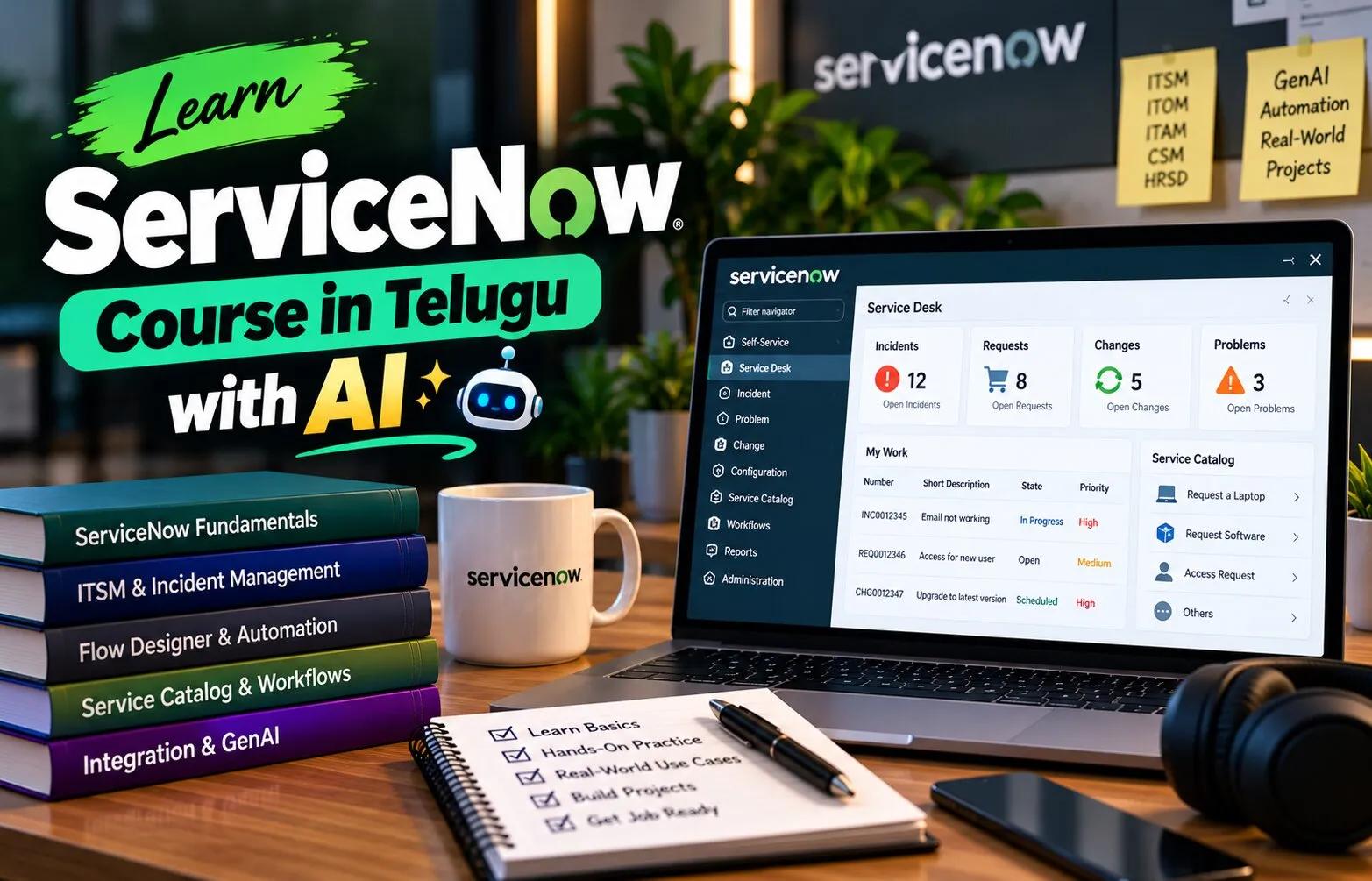
A ServiceNow Course in Telugu with AI can help learners understand Predictive Intelligence as a practical support capability rather than a replacement for ITSM processes. The goal is to learn how historical data can improve repetitive decisions, what makes a model reliable, and why data quality, review, and continuous monitoring are essential.
What Is Predictive Intelligence?
Predictive Intelligence uses machine learning to learn from historical records and make recommendations or predictions for new records.
In service management, it can support tasks such as:
Category prediction.
Assignment-group prediction.
Similar record identification.
Topic grouping.
Priority assistance.
Why Historical Data Matters
Machine learning depends heavily on examples.
Suppose thousands of past incidents contain:
Description.
Category.
Subcategory.
Assignment group.
Resolution.
If the data is consistent, the model may learn that certain types of text are associated with certain support teams.
If historical data is poor, predictions may also be poor.
For example, if agents frequently choose random categories just to close tickets, the model may learn those incorrect patterns.
Classification Example
A new ticket says:
“Unable to open SAP after role change. Authorization error displayed.”
A predictive model may suggest:
Category: Business Application.
Subcategory: SAP.
Assignment Group: SAP Security.
The agent can accept or modify the suggestion.
Over time, the organization can measure how often the recommendation was correct.
Automatic vs Assisted Classification
Not every prediction should be applied automatically.
A lower-risk workflow may show:
Suggested category.
Suggested assignment.
Confidence indicator where available.
The agent confirms the result.
Higher-confidence and lower-risk cases may later be automated more aggressively.
The correct approach depends on business risk and prediction quality.
Assignment Prediction
Assignment is one of the most useful areas for predictive support.
Service desks may receive thousands of incidents that need to reach specialist teams.
Manual routing can create:
Delays.
Reassignments.
SLA risk.
User frustration.
A model can learn from historical ticket descriptions and final assignment groups.
This can help new tickets reach the right team earlier.
Similar Incident Detection
Some issues repeat.
For example:
A new ticket reports:
“CRM login fails after morning update.”
The platform may find similar historical incidents involving the same application or error pattern.
Agents can review:
Past resolution.
Known workaround.
Related problem record.
Recent outage.
This reduces duplicated troubleshooting.
Clustering and Grouping
Predictive techniques can also help identify groups of related tickets.
Suppose many users submit slightly different descriptions:
“Email slow.”
“Outlook loading messages slowly.”
“Inbox takes long to refresh.”
These may represent one broader service issue.
Grouping similar records can help teams identify trends that might otherwise remain hidden.
Predictive Support for Prioritization
AI can help identify signals associated with high-impact incidents.
Examples include language suggesting:
Multiple users affected.
Critical application unavailable.
Business deadline at risk.
However, priority usually depends on formal impact and urgency rules.
AI should support the process, not override approved service-management policy without governance.
Data Preparation
Before building predictive models, teams should review historical records.
Important questions include:
Are categories consistent?
Are assignment groups accurate?
Are descriptions meaningful?
Are closure codes reliable?
Are duplicate records common?
Did organizational structures change?
Old data may contain patterns that no longer reflect the current support organization.
Training on outdated or inconsistent data can reduce model usefulness.
Feature Quality
Useful predictive information may come from:
Short description.
Detailed description.
Category.
Service.
Configuration item.
Location.
User context.
Other approved fields.
Sensitive or irrelevant fields should not be included simply because they are available.
The organization should understand which information is being used and why.
Model Evaluation
A model should be evaluated before broad automation.
Useful measures may include:
Prediction accuracy.
Precision.
Recall.
Acceptance rate.
Reassignment reduction.
Resolution-time impact.
The best metric depends on the use case.
For assignment prediction, reducing incorrect routing may matter more than maximizing one generic accuracy score.
Human Feedback
Agents can provide valuable feedback.
If the model recommends the wrong group, the corrected assignment becomes useful information for future improvement.
However, feedback should be reviewed carefully.
If agents themselves are inconsistent, the model can continue learning noisy patterns.
Clear process ownership remains important.
Concept Drift
Business environments change.
Applications are replaced.
Teams are reorganized.
Categories are renamed.
New services are introduced.
A model trained on last year's records may become less accurate.
This change in real-world patterns is often called drift.
Predictive systems should therefore be monitored and retrained when necessary.
Avoid Blind Automation
A prediction is not the same as a fact.
For example:
The model predicts Network Support with high confidence.
But the ticket involves a new application that the model has never seen.
Human review may still be needed.
AI-supported workflows should include fallback paths when the confidence or context is insufficient.
Practical Predictive Intelligence Exercise
Create a synthetic incident dataset containing:
Short Description.
Category.
Subcategory.
Assignment Group.
Priority.
Resolution Code.
Use examples from:
VPN.
Email.
Laptop.
SAP.
CRM.
Network.
Then design a predictive workflow:
Train on historical records.
Test category prediction.
Test assignment prediction.
Review incorrect predictions.
Clean inconsistent data.
Retrain.
Compare performance.
Decide which predictions remain agent-assisted.
Document why some predictions should not be fully automated.
Frequently Asked Questions
What does Predictive Intelligence do in ServiceNow?
It uses historical patterns to support tasks such as classification, assignment, similarity, and other predictive workflows.
Does Predictive Intelligence require good historical data?
Yes. Inconsistent categories, poor descriptions, and incorrect assignments can reduce prediction quality.
Can predictions be wrong?
Yes. Predictive models provide probabilistic recommendations and should be monitored continuously.
Why should models be retrained?
Business services, support groups, categories, and user behavior change over time, so older patterns may become less relevant.
Conclusion
A ServiceNow Course in Telugu with AI can help learners understand Predictive Intelligence as a data-driven extension of service management.
Historical records can help predict categories, assignment groups, and similar cases, reducing repetitive triage and making support workflows more efficient. The quality of these results depends on clean data, clear process definitions, appropriate model evaluation, and continuous monitoring.
The strongest implementation treats AI predictions as managed operational capabilities rather than automatic truth. When organizations combine good ITSM data with human review and regular improvement, Predictive Intelligence can become a useful part of faster and more consistent service delivery.